
There is a very specific moment I look forward to on every trip. It’s not arriving at the hotel, and it’s not the first bite of local food, though those are wonderful.
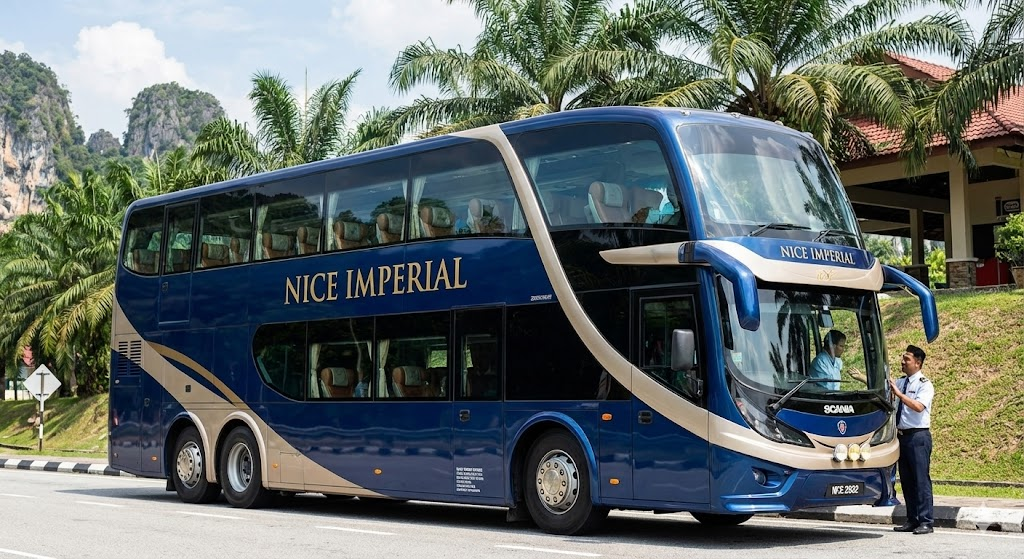
It’s the moment the heavy door hisses shut, sealing out the humid chaos of the bus terminal. The engine gives a deep, reassuring rumble beneath the floorboards, and the air conditioning kicks in with an arctic blast that promises sanctuary from the tropical heat outside. I sink back into a seat that feels less like public transport and more like a favorite armchair.
As the coach pulls away from the curb and merges onto the highway, I feel a profound sense of relief. For the next four, five, or eight hours, nobody needs anything from me. My only job is to watch Malaysia roll by outside my window.
I’ll be honest: for a long time, I was a “flight snob.” If I needed to get from Kuala Lumpur to Penang, or down to Johor Bahru, my instinct was to head to KLIA or Subang and hop on a budget flight. It seemed faster, more modern, more “efficient.”
But was it? By the time I factored in the expensive taxi ride to the airport, the security queues, the waiting at the gate, the cramped airplane seat, and the transit on the other end, I wasn’t saving much time at all. And I certainly wasn’t relaxed.
Then, on a whim a few years ago, booked a ticket on a “VIP” coach up north. That single trip completely changed my travel philosophy. It rekindled a love for the journey itself, something I think we often lose in our rush to just get there.
If you haven’t taken a long-distance bus in Malaysia recently, or if you’re visiting from a country where bus travel is synonymous with discomfort, you need to reset your expectations. The coach scene here is, quite frankly, incredible. It’s arguably one of the best-kept secrets of Southeast Asian travel.
The Malaysian “Super VIP” Standard
Let’s talk about the seats. This is the game-changer.
When you book a standard “VIP” or “Executive” coach in Malaysia (which you absolutely should—the price difference over economy is negligible for the upgrade in comfort), you aren’t getting a sad, upright plastic chair. You are usually getting a configuration of only three seats per row (two on one side of the aisle, one on the other).
These seats are massive. They are deeply cushioned thrones that recline so far back you are practically horizontal. They have footrests that pop up to support your legs. There is enough legroom for a giraffe to stretch out comfortably.
I have had better sleeps on the North-South Expressway at 3:00 AM than I have in some mid-range hotels. There is something hypnotizing about the hum of the road and the gentle swaying of the bus that just knocks me out.
Furthermore, the highways in Malaysia are world-class. The main arteries connecting Thailand to Singapore are smooth, well-maintained, and multi-laned. It makes for an incredibly stable ride.
The Window Seat Cinema
Beyond the sheer comfort, there is the visual aspect. When you fly, you see clouds, and then you land in a new city that looks much like the old city. You miss the connective tissue of the country.
On a coach, you watch the landscape transform. Heading north out of the concrete jungle of Kuala Lumpur, the city gives way to endless, neat rows of oil palms that look like a patterned carpet covering the hills. Suddenly, dramatic limestone karsts—ancient, sheer cliffs covered in jungle vines—erupt from the flat landscape in Perak. You pass through sleepy towns where life moves at a different pace, and you see the architecture shift reflecting local cultures.
Going up to the Cameron Highlands is an event in itself. The coach tackles winding roads, climbing higher and higher into the cool, misty air, past terraced tea plantations that are impossibly green. You can’t get that perspective at 35,000 feet.
Practicalities and Quirks
Of course, it’s not perfect, and there are quirks you need to know to love coach travel here.
The first rule of Malaysian coach travel is: Bring a sweater. I cannot stress this enough. The bus drivers seem locked in an eternal competition to see who can achieve cryogenic freezing temperatures inside their vehicles. It can be 35°C outside, and you will be shivering inside. A hoodie or a light blanket is essential survival gear.
Then there are the rest stops (R&Rs). These aren’t just quick bathroom breaks. Malaysian highway rest stops are culinary destinations. You have twenty minutes to sprint off the bus, grab a hot teh tarik, maybe some freshly cut guava with sour plum powder, or even a full plate of nasi kandar, and get back before the driver honks. It’s a chaotic, delicious part of the ritual.
Navigating the terminals can also be an adventure, though it’s getting much better. Kuala Lumpur’s Terminal Bersepadu Selatan (TBS) is practically an airport for buses—modern, huge, and computerized. It’s a far cry from the dusty, confusing lots of the past.
A Better Way to Move
I’ve come to believe that how you travel matters just as much as where you go. In a world obsessed with speed, taking the coach is an act of deliberate slowing down. It’s cheaper, yes, and often greener than flying short distances. But more than that, it’s a more humane way to travel.
It connects you to the ground beneath you. It allows you the mental space to read a book, listen to a whole album, or just daydream while staring out the window.
This passion for the road is really what drives me. I’ve realized that the biggest hurdle for many people isn’t that they dislike buses, it’s that they don’t know which buses to take. They don’t know the difference between a cramped economy ride and the blissful “Super VIP” experience.
That’s why I’m always telling people: give the coaches a chance. Do a little research, book the nice seats, pack your hoodie, and just sit back. You might find that the best part of your Malaysian holiday is the time spent in transit.